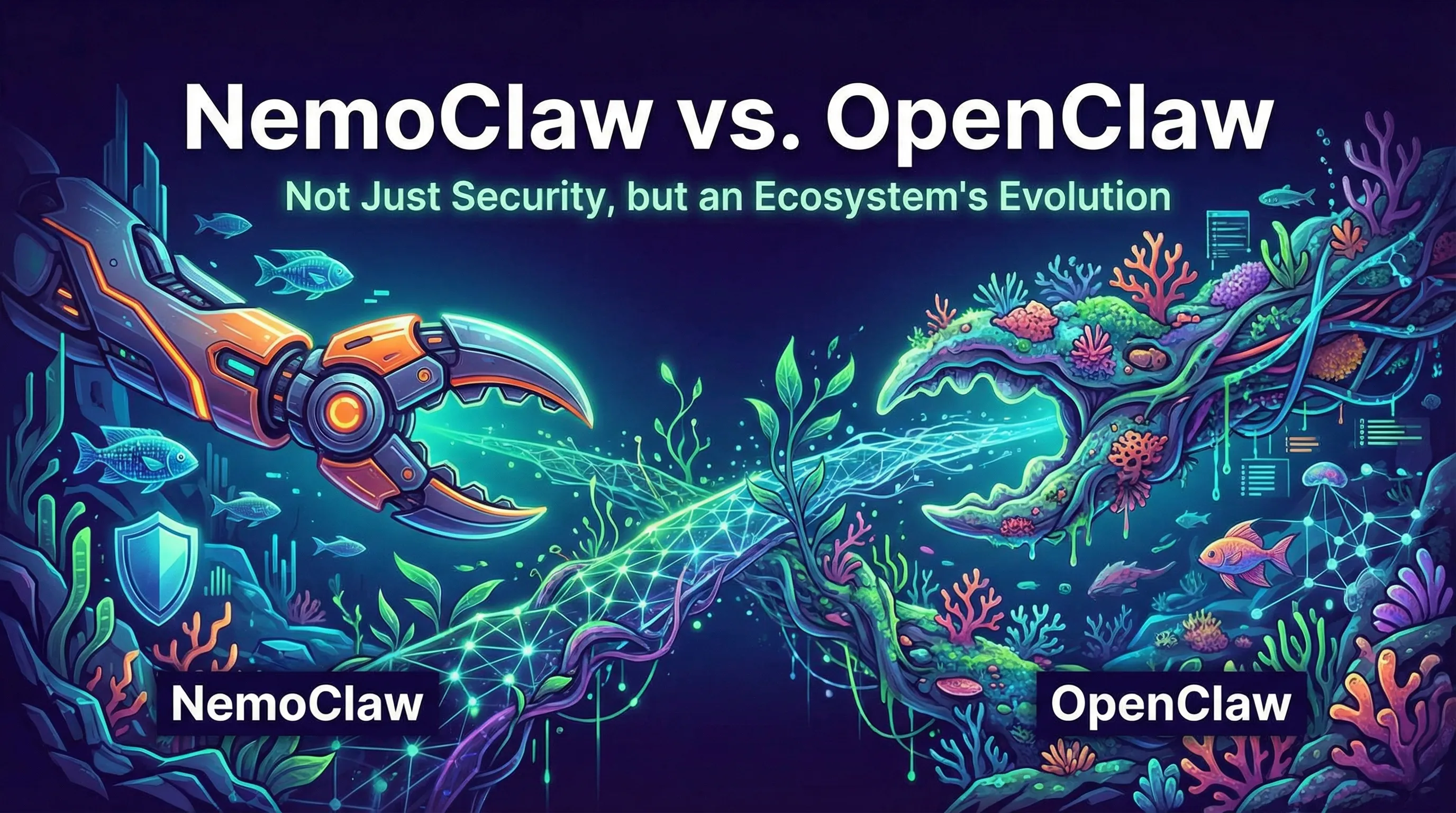
NemoClaw vs. OpenClaw: Not Just Security, but an Ecosystem's Evolution
OpenClaw lets you experience the future; NemoClaw makes that future secure reality. A deep dive into the core differences and use cases of this AI agent duo, and why cloud hosting might just be the optimal balance point.
It’s 3:00 AM, and your phone screen lights up. It’s not a push notification, but a message from your "Assistant": "Last night's code review is complete; 3 potential vulnerabilities were identified, and corresponding PRs have been submitted and merged. Additionally, the materials for your 10:00 AM meeting tomorrow have been compiled and sent to your email."
This isn't science fiction; it’s the daily reality for OpenClaw users. This AI agent framework—which burst onto the scene in late 2025—garnered over 320,000 GitHub stars in just 60 days, surpassing the decade-long record held by React. For the first time, it allowed developers to truly feel that a "digital colleague"—one that is tireless, capable of understanding complex instructions, and able to execute tasks autonomously—has truly stepped out of fiction and into reality.
However, immense power comes with commensurate risk. A series of exposed security vulnerabilities (CVEs), the discovery of malware within nearly 20% of the skills in the ClawHub library, and tens of thousands of OpenClaw instances worldwide left exposed to the public internet without any protection—these factors served as a sobering splash of cold water on this technological euphoria.
And so, at the GTC conference in March 2026, NVIDIA presented its answer: NemoClaw.
At first glance, many might assume they are rivals. However, a more accurate analogy is this: OpenClaw is the brilliant yet somewhat audacious explorer, while NemoClaw is the deep-sea submersible—custom-built for that very explorer—equipped with a full suite of safety protocols and life-support systems.
Core Positioning: From Personal Experiments to Enterprise-Grade Missions
To understand the distinction between the two, one must first set aside the "which is better?" mindset and focus instead on their original design intent.
At its core, OpenClaw is an open-source framework for autonomous AI agents. Its objective is maximum flexibility, enabling you to quickly launch an AI agent on your local machine—connecting to your APIs, controlling your browser, and managing your files. It acts like a powerful Swiss Army knife, encouraging you to deconstruct, modify, and experiment. If you ask, "What can it do?", the answer is almost invariably: "Any digital task you can imagine." Its primary battleground is the developer's local environment, and its core value lies in rapid prototyping and personal workflow automation.
NemoClaw—as described in its official installation scripts and documentation—is not a new framework built from scratch. Instead, it is characterized as "launching OpenClaw within an OpenShell sandbox." Simply put: NemoClaw = OpenClaw + a secure, controllable execution environment (sandbox) built by NVIDIA + deep-level optimizations for models such as Nemotron. Its goal is to enable OpenClaw to operate safely, reliably, and controllably within production environments, making it suitable for use by teams and enterprises. Its focus is not merely on what can be done, but rather within what boundaries and in what controlled manner those actions are executed.
Security Architecture: Application-Layer Autonomy vs. Kernel-Level Containment
This constitutes the most fundamental—and arguably the most critical—difference between the two, dictating their entirely distinct use cases.
OpenClaw’s security model is "self-regulated." It manages its own behavior at the application layer through mechanisms such as API whitelists and pairing codes. While this grants the agent immense flexibility, it also implies a potential vulnerability: if the agent itself is "persuaded" or compromised—for instance, through a sophisticated prompt injection attack—it may be able to bypass the very rules it established for itself. As security researchers have warned, this introduces inherent risks when deploying the framework in environments involving sensitive data or critical systems. Running OpenClaw securely typically requires users to independently set up a comprehensive suite of additional infrastructure safeguards—such as network isolation and file system restrictions—which undoubtedly raises the barrier to entry.
NemoClaw’s security is "externally enforced"; it functions as a true sandbox—a secure cage. Its security model is established at the operating system kernel level and typically encompasses four layers of isolation: network, file system, process, and reasoning routing. Crucially, these restrictions are enforced outside the processes managed by the OpenClaw agent. Even if the agent were to be completely compromised, it would remain powerless to breach the sandbox's defenses. Network access is strictly confined within a set of predefined policies; file system access is restricted solely to the /sandbox directory; and dangerous system calls are blocked outright.
The most tangible manifestation of this security is NemoClaw’s "Approval TUI" (Text-based User Interface). When the agent attempts to access a network address that is not on the whitelist, the operator immediately receives an interactive prompt, allowing them to choose whether to approve or deny the request. This level of real-time, visual control is a feature that OpenClaw currently lacks.
Cost and Complexity: Flexible and Lightweight vs. Robust and Reliable
Making a choice inevitably entails making trade-offs.
OpenClaw is renowned for its "one-click installation" and its extremely low hardware requirements. You can have it up and running on a MacBook in under ten minutes. The primary costs stem from the fees associated with the large language model APIs you utilize (such as Claude or GPT-4), ranging from a few dollars per month to potentially hundreds of dollars in cases involving "runaway workflows."
Getting started with NemoClaw, conversely, is a far more complex undertaking. Judging by the provided installation scripts, it requires a Linux environment (Ubuntu 22.04+ recommended), Docker, and a minimum of 8GB of RAM. The installation process involves a series of steps, including cloning repositories, resolving dependencies, and building plugins. While it constructs a formidable fortress for you, the act of building that fortress itself demands both time and resources. The software itself is free; however, the underlying infrastructure costs for hosting it (approximately $20–$50 per month)—along with potential future fees for the NVIDIA Nemotron API—constitute its baseline cost.
Which Should You Choose?
This is not a binary, either-or decision; rather, it is a question of "when to use which one."
When You Should Choose OpenClaw:
- Personal Projects & Wild Ideas: You want to automate personal email tasks, organize photos, assist with programming, or conduct any imaginative, unconventional experiments.
- Rapid Prototyping: You need to quickly validate an AI agent workflow concept, prioritizing speed far above security.
- Ecosystem Needs: You want to fully leverage the tens of thousands of community-contributed skills available on ClawHub (though, naturally, you must exercise your own discretion regarding potential risks).
- Controlled Environment: You are running it on an isolated virtual machine or a spare computer that is not connected to your core business operations.
When You Should Consider NemoClaw:
- Production Deployment: You plan to have AI agents process real customer data, access internal databases, or operate critical business systems.
- Compliance & Audit Requirements: In industries such as finance or healthcare, you require complete, immutable operational logs.
- Team Collaboration: You need to establish unified, manageable security policies for multiple AI agents.
- Already in the NVIDIA Ecosystem: You are currently using NVIDIA hardware and wish to achieve optimal performance for local models (such as Nemotron).
Action Guide: No Need to Choose Just One—Try the Cloud-Based Best Practice
By this point, you might be feeling torn: you covet OpenClaw’s powerful autonomous capabilities and vibrant ecosystem, yet you also admire the production-grade security and control demonstrated by NVIDIA in NemoClaw. For personal use, is it really necessary to set up a complex NemoClaw sandbox environment?
There is an option—often overlooked—that perfectly balances these two aspects: using a secure, cloud-hosted OpenClaw service.
This is precisely the value that JustOpenClaw delivers. Its tagline is: "Zero Code, 24/7 Online—Your Personal OpenClaw." It resolves the most vexing issues associated with a native OpenClaw installation:
- Skip Complex Configuration: No need to battle with port conflicts, Python version mismatches, or Docker Compose errors.
- Enterprise-Grade Isolation: Your OpenClaw instance runs within an independent cloud environment, completely isolated from other users—essentially providing you with an inherent layer of "sandbox-like" protection.
- Eliminate Maintenance Burdens: Updates, security patches, and scalability are all handled by the service provider.
- Out-of-the-box and Always-On: Simply log in and start working—no need to worry about your AI agent stopping the moment your local computer shuts down.
For the vast majority of individual users, small teams, and even startups, running OpenClaw directly on a service like JustOpenClaw represents the most cost-effective, fastest-to-deploy, and—crucially—far more secure alternative to running it locally without any protective safeguards. You don't need to be a system security expert to enjoy a relatively secure and stable self-hosted AI agent service.
Conclusion
The comparison between NemoClaw and OpenClaw is far more than just a contest between two software applications. It marks the transition of AI agent technology from a wild "frontier era" into a mature stage of development—one that now requires "traffic rules" and "urban planning."
OpenClaw has demonstrated the boundless potential of AI agents, igniting the spark of a revolution. NemoClaw—along with cloud-based services like JustOpenClaw—is now building the reliable infrastructure and safety systems for this revolution, ensuring that the flame burns safely and enduringly, illuminating a true future of productivity.
Your choice depends on where you currently stand: are you at the vanguard of exploration, or are you ready to build a sustainable city within the newly pioneered territory? Fortunately, regardless of which role you play, you now have the right tools for the job.